Reception Desk Buying Guide: 7 Things to Get Right Before You Buy
A reception desk is one of the first things visitors see — but choosing the right one involves much more than appearance. Here’s what to consider before you specify or buy one.
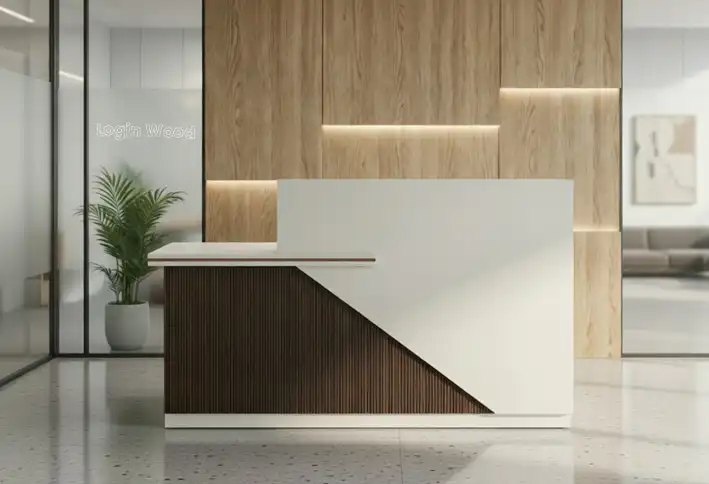
A reception desk has a difficult job. It needs to make the right first impression, work comfortably for the person sitting behind it, survive years of daily use, and fit the physical constraints of your lobby. That means choosing one based purely on how it looks in a catalogue is rarely enough.
Whether you’re setting up a new office, renovating an existing reception area, or specifying furniture for a client, these are the details worth considering before you finalise the design.
1. Start With the Space, Not the Desk
The first question shouldn’t be “Which reception desk do we like?” It should be “How much space do we actually have?”
A reception desk can look perfectly proportioned in a product photograph and feel completely different once it is placed inside a real lobby. Measure the available floor area and consider the space required behind and around the desk.
- Clear floor space available for the reception area
- Walking clearance behind the desk
- Number of people who will work at the desk
- Position of the entrance and visitor movement
- Space required for seating or a waiting area
- Space for deliveries, courier packages or visitor check-in
The goal isn’t simply to make the desk fit. The entire reception area should remain comfortable to move through and easy to use.
A well-designed reception desk should fit the circulation of the lobby — not force the lobby to work around the furniture.
2. Think About the Person Working Behind It
Reception areas are designed for visitors, but the person behind the desk may spend most of their working day there. That makes ergonomics just as important as appearance.
Consider the working height, legroom, monitor position, chair clearance and the amount of usable surface available for everyday tasks.
A reception desk that looks impressive from the front but leaves the receptionist with an awkward working position isn’t a successful design. The visitor-facing appearance and the employee-facing functionality need to work together.
3. Choose Materials for the Reality of the Space
Reception desks are exposed to considerably more interaction than many other pieces of office furniture. People lean against them, place bags and packages on them, clean them frequently, and use the surrounding area throughout the day.
That makes the choice of finish more than a visual decision.
- Laminate: A practical option for busy environments, with easy maintenance and a wide range of finishes.
- Veneer: Provides a natural material appearance and can create a more refined, furniture-led look.
- Edge banding: Often overlooked, but important for the long-term appearance and durability of exposed edges.
If the reception area experiences heavy daily traffic, ask about the actual performance and maintenance requirements of the chosen finish rather than judging it only by how it looks in a photograph or render.
4. Don’t Forget What the Desk Has to Hide
A reception desk often looks simple from the visitor’s side because it is hiding a surprisingly complicated working area behind it.
Computers, monitors, telephones, chargers, stationery, documents, visitor materials and other everyday items all need somewhere to go.
Good storage and cable management keep these things accessible to staff without allowing them to dominate the appearance of the reception area.
Before choosing a design, think through what will actually be used at the desk every day. A beautiful reception counter with nowhere to put essential equipment will quickly become cluttered.
The best storage is the storage you don’t notice — everything is accessible to staff while the visitor sees a clean, composed space.
5. Design for the Visitor’s First Impression
The reception area is often the first physical point of contact between a company and its visitors. It naturally influences how the rest of the workplace is perceived.
But creating a strong first impression doesn’t necessarily mean choosing the most elaborate design available.
Proportion, materials, lighting, surrounding furniture and the overall cleanliness of the space all contribute to how the reception feels.
A well-designed desk should feel like part of the architecture of the office, rather than an isolated piece of furniture placed in front of a wall.
6. Consider Whether Standard Is Enough
Standard reception desks can work extremely well when the space and requirements are straightforward. But some projects have constraints that make an off-the-shelf design less suitable.
The desk may need a specific width, unusual configuration, additional storage, particular finishes, integrated cable routing, or a design language that matches the rest of the office.
That’s where customization becomes useful. Instead of changing the space around the furniture, the furniture can be developed around the space and the way it will actually be used.
7. Look Beyond the Front Panel
The front of a reception desk is usually what gets the most attention in a catalogue. But some of the details that determine whether the desk works well are almost invisible once the project is finished.
- Quality of edge finishing
- Structural stability
- Cable routing
- Storage accessibility
- Work surface dimensions
- Ease of cleaning and maintenance
- Fit with the surrounding architecture
These details may not be what catches your eye first, but they are what you notice after using the desk every day.
A Simple Reception Desk Checklist
- Have we measured the complete reception area?
- Is there enough clearance for people to move comfortably?
- How many people will work behind the desk?
- Does the desk provide a comfortable working position?
- Where will monitors, phones and other equipment go?
- Is there enough concealed storage?
- Are the chosen materials suitable for the expected level of use?
- Does the design fit the architecture and identity of the office?
- Would a customised configuration make more sense than a standard one?
The Right Reception Desk Is About More Than Appearance
A reception desk should look good, but that is only one part of the decision. The better approach is to consider the complete experience — how visitors see it, how employees use it, how it performs over time, and how naturally it fits into the space around it.
For projects where dimensions, finishes or configurations need to be adapted to the space, LOGIN WOOD® manufactures reception furniture at its Pune facility, allowing the design to be developed around the project’s requirements rather than relying only on fixed catalogue dimensions.
The best reception desk is ultimately the one that feels right on day one — and continues to work just as well years later.
Office furniture, manufactured in Pune.
LOGIN WOOD® is a Pune-based office furniture manufacturer producing modular workstations, reception desks, executive cabins, conference tables and other workplace solutions for modern offices.