
Office Furniture · Buying Guide
Reception Desk Buying Guide: 7 Things to Get Right Before You Buy
A reception desk is one of the first things visitors see — but choosing the right one involves much more than appearance. Here’s what to consider before you specify or buy one.
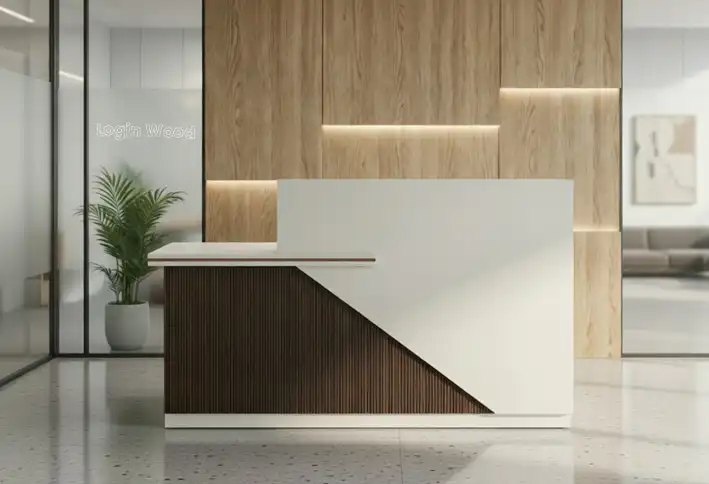
Reception desk — LOGIN WOOD®
A reception desk has a difficult job. It needs to make the right first impression, work comfortably for the person sitting behind it, survive years of daily use, and fit the physical constraints of your lobby. That means choosing one based purely on how it looks in a catalogue is rarely enough.
Whether you’re setting up a new office, renovating an existing reception area, or specifying furniture for a client, these are the details worth considering before you finalise the design.
1. Start With the Space, Not the Desk
The first question shouldn’t be “Which reception desk do we like?” It should be “How much space do we actually have?”
A reception desk can look perfectly proportioned in a product photograph and feel completely different once it is placed inside a real lobby. Measure the available floor area and consider the space required behind and around the desk.
- Clear floor space available for the reception area
- Walking clearance behind the desk
- Number of people who will work at the desk
- Position of the entrance and visitor movement
- Space required for seating or a waiting area
- Space for deliveries, courier packages or visitor check-in
The goal isn’t simply to make the desk fit. The entire reception area should remain comfortable to move through and easy to use.
A well-designed reception desk should fit the circulation of the lobby — not force the lobby to work around the furniture.
2. Think About the Person Working Behind It
Reception areas are designed for visitors, but the person behind the desk may spend most of their working day there. That makes ergonomics just as important as appearance.
Consider the working height, legroom, monitor position, chair clearance and the amount of usable surface available for everyday tasks.
A reception desk that looks impressive from the front but leaves the receptionist with an awkward working position isn’t a successful design. The visitor-facing appearance and the employee-facing functionality need to work together.
3. Choose Materials for the Reality of the Space
Reception desks are exposed to considerably more interaction than many other pieces of office furniture. People lean against them, place bags and packages on them, clean them frequently, and use the surrounding area throughout the day.
That makes the choice of finish more than a visual decision.
- Laminate: A practical option for busy environments, with easy maintenance and a wide range of finishes.
- Veneer: Provides a natural material appearance and can create a more refined, furniture-led look.
- Edge banding: Often overlooked, but important for the long-term appearance and durability of exposed edges.
If the reception area experiences heavy daily traffic, ask about the actual performance and maintenance requirements of the chosen finish rather than judging it only by how it looks in a photograph or render.
4. Don’t Forget What the Desk Has to Hide
A reception desk often looks simple from the visitor’s side because it is hiding a surprisingly complicated working area behind it.
Computers, monitors, telephones, chargers, stationery, documents, visitor materials and other everyday items all need somewhere to go.
Good storage and cable management keep these things accessible to staff without allowing them to dominate the appearance of the reception area.
Before choosing a design, think through what will actually be used at the desk every day. A beautiful reception counter with nowhere to put essential equipment will quickly become cluttered.
The best storage is the storage you don’t notice — everything is accessible to staff while the visitor sees a clean, composed space.
5. Design for the Visitor’s First Impression
The reception area is often the first physical point of contact between a company and its visitors. It naturally influences how the rest of the workplace is perceived.
But creating a strong first impression doesn’t necessarily mean choosing the most elaborate design available.
Proportion, materials, lighting, surrounding furniture and the overall cleanliness of the space all contribute to how the reception feels.
A well-designed desk should feel like part of the architecture of the office, rather than an isolated piece of furniture placed in front of a wall.
6. Consider Whether Standard Is Enough
Standard reception desks can work extremely well when the space and requirements are straightforward. But some projects have constraints that make an off-the-shelf design less suitable.
The desk may need a specific width, unusual configuration, additional storage, particular finishes, integrated cable routing, or a design language that matches the rest of the office.
That’s where customization becomes useful. Instead of changing the space around the furniture, the furniture can be developed around the space and the way it will actually be used.
7. Look Beyond the Front Panel
The front of a reception desk is usually what gets the most attention in a catalogue. But some of the details that determine whether the desk works well are almost invisible once the project is finished.
- Quality of edge finishing
- Structural stability
- Cable routing
- Storage accessibility
- Work surface dimensions
- Ease of cleaning and maintenance
- Fit with the surrounding architecture
These details may not be what catches your eye first, but they are what you notice after using the desk every day.
A Simple Reception Desk Checklist
- Have we measured the complete reception area?
- Is there enough clearance for people to move comfortably?
- How many people will work behind the desk?
- Does the desk provide a comfortable working position?
- Where will monitors, phones and other equipment go?
- Is there enough concealed storage?
- Are the chosen materials suitable for the expected level of use?
- Does the design fit the architecture and identity of the office?
- Would a customised configuration make more sense than a standard one?
The Right Reception Desk Is About More Than Appearance
A reception desk should look good, but that is only one part of the decision. The better approach is to consider the complete experience — how visitors see it, how employees use it, how it performs over time, and how naturally it fits into the space around it.
For projects where dimensions, finishes or configurations need to be adapted to the space, LOGIN WOOD® manufactures reception furniture at its Pune facility, allowing the design to be developed around the project’s requirements rather than relying only on fixed catalogue dimensions.
The best reception desk is ultimately the one that feels right on day one — and continues to work just as well years later.
About LOGIN WOOD®
Office furniture, manufactured in Pune.
LOGIN WOOD® is a Pune-based office furniture manufacturer producing modular workstations, reception desks, executive cabins, conference tables and other workplace solutions for modern offices.
Workplace Design · Comparison
Modular Workstations vs. Traditional Desks: Which Is Right for Your Office?
The choice between modular workstations and individual desks affects space, flexibility, cost and the way your team works. Here’s how the two actually compare.
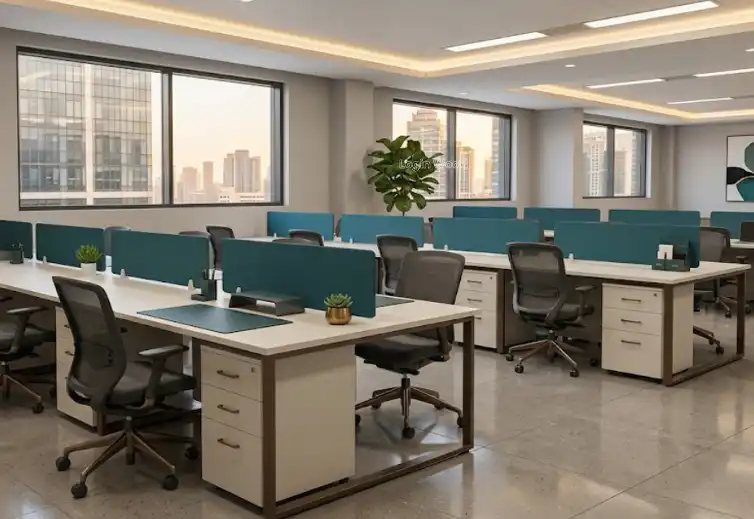
Modular workstation
The short answer
If you’re setting up a new office or planning a refresh, one of the first decisions you’ll run into is a basic one: modular workstations, or traditional individual desks?
It sounds like a small choice, but it shapes almost everything that comes after it — how many people you can fit, how easily you can grow, and how much you’ll spend doing it again in two years.
01 / THE BASICS
What’s the Difference, Really?
Traditional desks are standalone units — each one is its own piece of furniture, usually with a fixed size and a fixed spot. They’re familiar, simple to buy, and easy to picture.
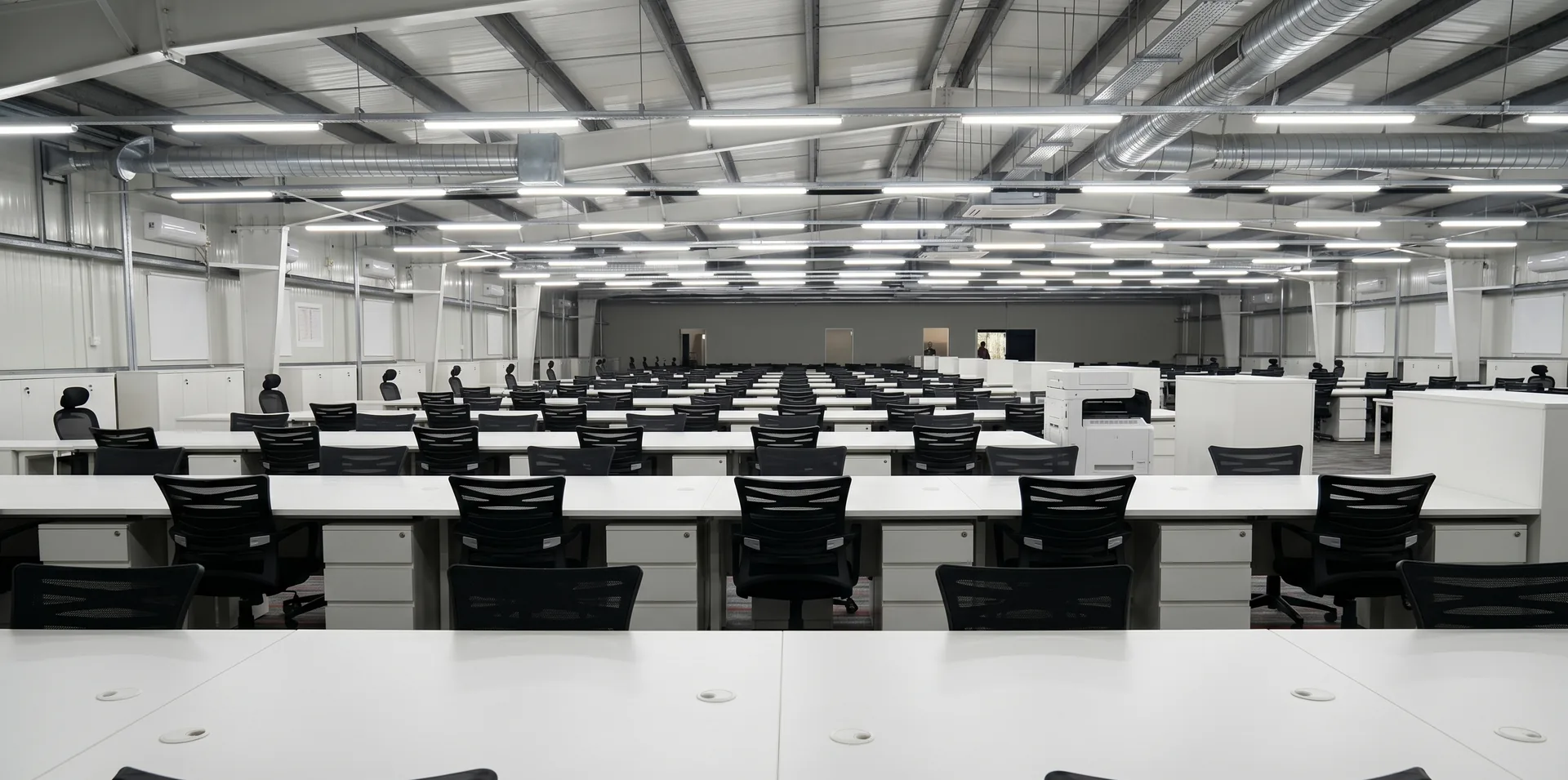
Modular workstations are built from a shared system of panels, desktops, and connectors that link together into clusters — benches of 2, 4, 6, or more seats sharing a footprint, often with built-in cable management and privacy screens between seats.
The difference isn’t just aesthetic. It’s structural — and that’s where the real trade-offs show up.
02 / SPACE
Space Efficiency
This is where modular systems usually win, and by a meaningful margin. Traditional desks each need their own clearance on every side, which adds up fast across a floor. Modular clusters share edges and walkways, so the same headcount typically fits into less square footage — which matters a lot in cities like Pune, where office rent is not getting cheaper.
If your floor plan is tight, or you’re trying to fit more people into an existing lease before committing to a bigger space, modular is usually the more space-efficient path.
At a glance
Two systems. Very different ways of using space.
Modular Workstations
Built as a connected system for teams and changing layouts.
- Efficient use of floor area
- Easy to add or rearrange seats
- Shared structure and cable management
- Good fit for collaborative teams
Traditional Desks
Standalone furniture with greater separation between users.
- Simple standalone setup
- Easy to move individually
- More natural separation
- Useful for smaller, stable teams
03 / FLEXIBILITY
Flexibility When Your Team Changes
Teams grow, shrink, and reorganize more often than most people plan for. This is the single biggest advantage of modular furniture: individual components can be added, removed, or rearranged without replacing the whole setup.
A cluster of 4 can become a cluster of 6. A team that moves to a new floor can take their configuration with them instead of starting over.
Traditional desks don’t offer that same flexibility. When headcount changes, you’re often buying new pieces or living with an awkward layout until the next furniture cycle.
04 / COST
Cost Over Time
Traditional desks can look cheaper upfront, especially for a small office. But the comparison changes once you factor in what happens after the initial purchase.
Every time your team reconfigures, traditional setups often mean new purchases. Modular systems are designed to be reconfigured using what you already own — which is where the long-term savings tend to show up.
“The cheapest setup on day one isn’t necessarily the least expensive setup over the life of an office.”
Think beyond the initial purchase05 / WORK STYLE
Collaboration vs. Privacy
Modular clusters are generally better for teams that collaborate often — shared desk surfaces and close proximity make quick conversations easier. Traditional desks, spaced further apart, naturally offer a bit more individual privacy and fewer distractions.
Neither is universally “better” here — it depends on how your team actually works day to day. Sales and support teams that talk constantly often prefer clusters. Roles that need deep, uninterrupted focus sometimes do better with more separation.
Make the choice based on your office
So Which One Should You Choose?
Choose modular workstations if…
- Your headcount is likely to change
- Your available space is limited
- Your teams collaborate closely
- You want furniture that can be reconfigured rather than replaced
Choose traditional desks if…
- Your team is small and stable
- Your space isn’t a constraint
- Your work is mostly independent
- Individual separation is more important to your workflow
Many offices actually land somewhere in between — modular clusters for open teams, with a few traditional desks or private cabins for roles that need more separation.
LOGIN WOOD®
Built to match either way.
At LOGIN WOOD®, we manufacture both modular workstations and traditional desking, factory-direct from our own facility in Pune — so the decision comes down to what actually suits your team, not what’s easiest for us to supply. If you’re not sure which direction makes sense for your office, share your layout and headcount and we’ll help you work it out.